Monday, 30 November 2009
Preliminary Task
The start of the preliminary task involved writing a story board for are movie. These storyboards had to show what was going to go on each scene and include the dialogue which would be used.
The movie itself had to feature lots of different techniques and different camera angles, which we had learnt about in previous lessons.
This included: match on match action and shot reverse shot.
After filming the scenes from the storyboard, we had to edit the footage to make it into a movie. This involved cutting clips to the correct spot and making sure the movie ran smoothly. This gave the movie continuity which is important when making a film.
Overall I am happy with film. We included match on match action shots and shot reverse shots. Th movie was edited well and had continuity. However, if we had more time I would of added titles to the movie and cut out the background sound at certain points.

Friday, 20 November 2009
Film Openings & Credits Research
Apocalypse Now
How does the director/producer 'hook' the audience?
The scene starts of with a tropical landscape. Which then ends up being destroyed by fire and explosions. The director lets us know the film is about the Vietnam war and that you can expect to you see lots of destruction and violence in the film.
What techniques are used?
Quick flashback images of war are used - to show how the war haunts him
It also shows how obsessed the guy is with war - he says "when im in the jungle all i think about is being home and when im home all i think about is being in the jungle"
Non-diagetic sound used to make the scene seem dream like
Blade Runner
How does the director 'hook' the audience?
Titles used to create tension
Titles also used to give background information
Los Angeles- Fire - pollution, dangerous- audience in shock by how much LA has changed
Futuristic city
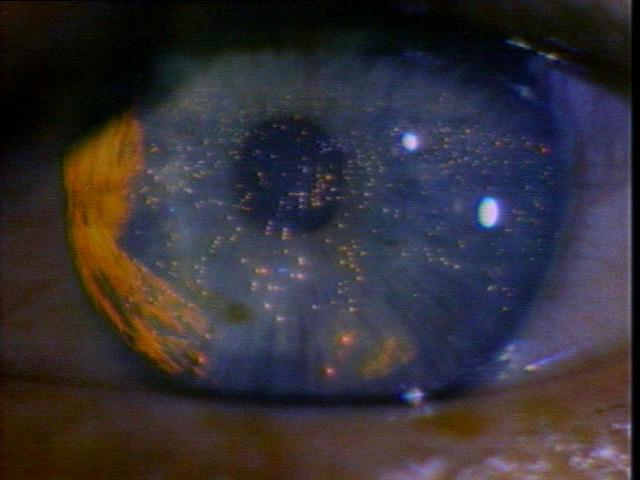
Eye - looking at fire- destruction? Importance of the eye - you can only tell who is replicant by looking at there eyes
What techniques are used?
Atmosphere - tense- just voices, no added sound, frustration?
Los Angeles - Dark/ oppressive/ its raining/ no nature - unhappiness
28 days later
How does the director 'hook' the audience?

Enigma questions - what is rage? Where is everyone? Why have they gone?
The doctor is scared of rage - shows us we should be scared?
What techniques are used?
Jumpy camera
Short shots
Quick cuts
Loud sounds All of this creates tension
dark
No sound - isolation, intensity, nothing
A clockwork orange
How does the director 'hook' the audience?
Alex is staring at you/camera
Why is he dressed weirdly? why are they used funny language? why are they drinking milk? There are lots of questions that you as the audience want to find the answer to?
What techniques are used?
A simple, tracking shot reveals everything slowly
Voice over of Alex talking about his gang
Music - creepy, eery, intense, creates tension and insecurity
Razing Arizona
How does the director 'hook' the audience?
Starts off with a mini film at the start of the actual film. This mini film is funny and draws you closer to the characters. You become more fond of the characters and care what happens to them. When they can't have children, you feel sorry for them
What techniques are used?
Voice over - we hear it from above , point of view voice
From this voice over we know the guys emotions and feelings and this makes us empathise for them
'snapshot' - seeing camera shots of the past
How does the director/producer 'hook' the audience?
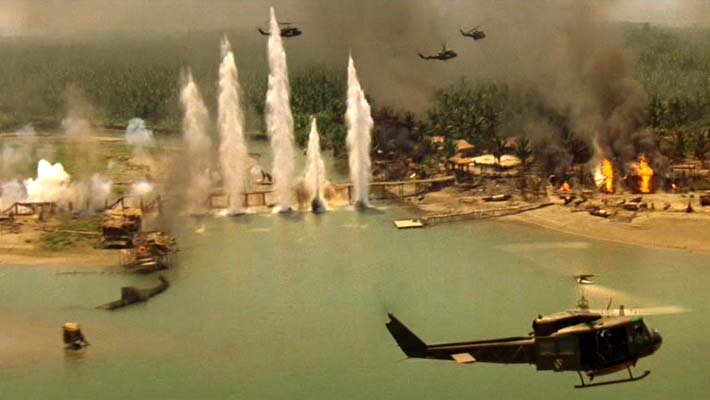
The scene starts of with a tropical landscape. Which then ends up being destroyed by fire and explosions. The director lets us know the film is about the Vietnam war and that you can expect to you see lots of destruction and violence in the film.
What techniques are used?
Quick flashback images of war are used - to show how the war haunts him
It also shows how obsessed the guy is with war - he says "when im in the jungle all i think about is being home and when im home all i think about is being in the jungle"
Non-diagetic sound used to make the scene seem dream like
Blade Runner
How does the director 'hook' the audience?
Titles used to create tension
Titles also used to give background information
Los Angeles- Fire - pollution, dangerous- audience in shock by how much LA has changed
Futuristic city
Eye - looking at fire- destruction? Importance of the eye - you can only tell who is replicant by looking at there eyes
What techniques are used?
Atmosphere - tense- just voices, no added sound, frustration?
Los Angeles - Dark/ oppressive/ its raining/ no nature - unhappiness
28 days later
How does the director 'hook' the audience?

Enigma questions - what is rage? Where is everyone? Why have they gone?
The doctor is scared of rage - shows us we should be scared?
What techniques are used?
Jumpy camera
Short shots
Quick cuts
Loud sounds All of this creates tension
dark
No sound - isolation, intensity, nothing
A clockwork orange
How does the director 'hook' the audience?

Alex is staring at you/camera
Why is he dressed weirdly? why are they used funny language? why are they drinking milk? There are lots of questions that you as the audience want to find the answer to?
What techniques are used?
A simple, tracking shot reveals everything slowly
Voice over of Alex talking about his gang
Music - creepy, eery, intense, creates tension and insecurity
Razing Arizona
How does the director 'hook' the audience?
Starts off with a mini film at the start of the actual film. This mini film is funny and draws you closer to the characters. You become more fond of the characters and care what happens to them. When they can't have children, you feel sorry for them

What techniques are used?
Voice over - we hear it from above , point of view voice
From this voice over we know the guys emotions and feelings and this makes us empathise for them
'snapshot' - seeing camera shots of the past
Friday, 6 November 2009
Camera Shots

180 degree rule
In Film Production the 180 degree rule refers to the film editing theory that your actors should have the same right – left relationship with each other. The 180 rule is a standard convention that just about every professional feature movie obeys.
Match on match action
A cut made on action or movement between two shots in which the action has been overlapped either by repetition of the action or by the use of more than one camera. (Film Editing)

Shot reverse shot
Conventional technique of cinematography and editing for the filming of dialogue. In the classic shot/reverse shot sequence, the camera frames each speaker (usually 2-4) in medium close-up as he or she recites a line of dialogue. The shoulder or profile of the listener can often be seen, slightly out of focus on the edge of the frame, while the camera is focused on the face of the speaker.
Point-of-View
Shot/Reverse Shot allows the spectator ("you") to occupy the listener's point of view. However, because both characters alternate between speaking and listening, the spectator is omniscient, an outside observer. There is visual logic in this design: character A speaks in frame - cut - character B speaks in frame.
The Affect of Speech
Directors may also use Shot/Reverse Shot to observe the way in which a speaker's words affect the listener. To accomplish this, the camera will first alternate between speakers. If, for instance, one speaker communicates a negative statement ("Our relationship is over"), the camera will turn to frame the listener, not the speaker. As the speaker talks, the listener visually responds through (perhaps) tears, frowns, or more subtle variations.
Monday, 2 November 2009
Techniques used in Psycho


Use dialogue for distraction
The scene when the Norman is being distracted by Sam as Lila searches through the house trying to find Norman’s mother
Point of view editing
Near the end, in the scene where Lila turns the mother’s skeleton around and Norman as his mother comes into the cellar. It’s all from Lila’s point of view
Montage that gives control
The shower seen where Marianne gets stabbed repeatedly in the back by Norman (as his mother); this is a montage as it shows his hand and then her back as a montage.
Techniques used in vertigo


Use dialogue for distraction
The first scene of Vertigo after the chase when Scotty is talking to Midge about other topics to distract talking about his illness, vertigo.
Point of view editing
When Scotty is following Madeline and she walks into the art gallery to look at the painting of Carlotta and it looks from Scotty’s point of view.
Montage that gives control
When Judie has a flashback of what happened at the bell tower with Madeline’s husband and how they set it up to make it look like she jumped off of the top.
Alfred Hitchcock Research

Alfred Hitchcock Techniques
1. The mind of the audience
2. Frame for emotion
3. Camera is not a camera
4. Use dialogue for distraction
5. Point of view editing
6. Montage gives control
7. Keep the story simple
8. Characters must break cliche
9. Use humour to add tension
10. Two things happening at once
11. Suspense is information
12. Surprise and text - provide the unexpected
Subscribe to:
Comments (Atom)

